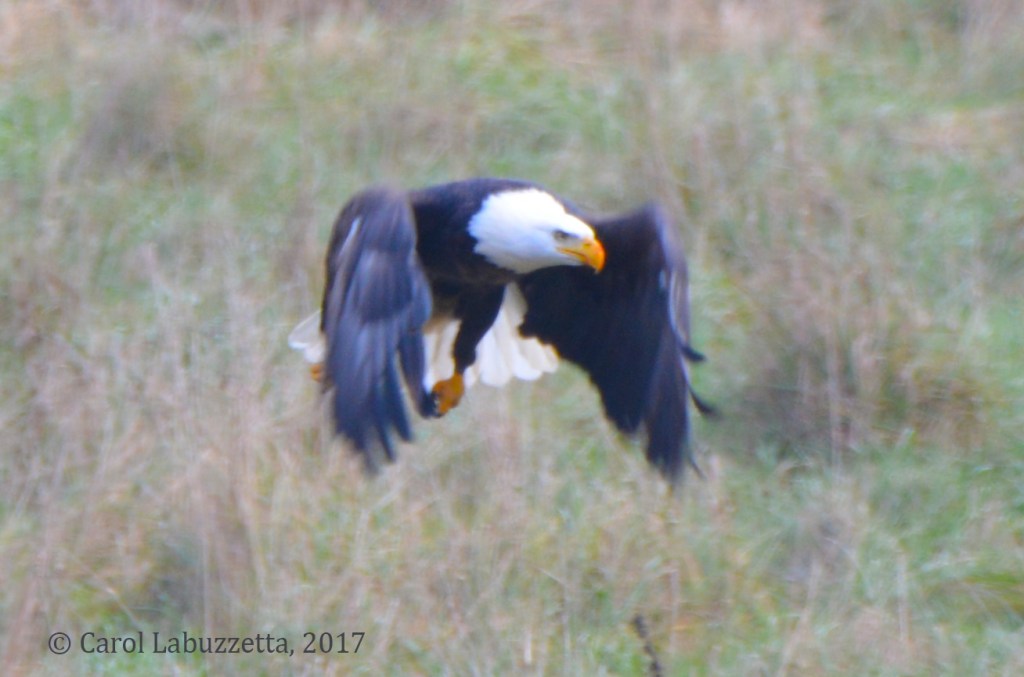
While we were driving our son back to school on Sunday, we crossed the great Mississippi River. Due to the mild weather, parts of the river are still open and not frozen. There, in the trees, lining one of the pieces of land in the slough, were a pair of Bald Eagles, resplendently sitting with their white heads, tails, and orange beaks visible between the branches!
My husband spotted them first, calling out to my and our son to quickly look where he was pointing. Seeing Eagles always gives my husband and I a thrill, as we recall them being placed on the endangered species list when we were children. We recounted this to our son, who fortunately, has been able to gaze at these majestic birds over his entire life.
In the early 1960’s Rachel Carson’s book Silent Spring highlighted the environmental dangers of pesticide use. Sure enough, it was found that DDT, a common pesticide at the time, was poisoning Eagles through their consumption of contaminated fish. Eagles mainly eat fish and carrion. Simultaneous problems of decreased habitat and of being shot by humans (before this was illegal), compounded the poisoning issue. Eagles were in short supply. I know I never saw one until I moved to the midwest, right before the turn of the century!
This brief history explained to our son our obvious joy when we had an eagle sighting! There was a time that our beautiful national symbol was endangered, threatened, and on the decline. According to the USFWS, only 487 nesting pairs existed in 1963. Extinction was possible. This is a story we might want to share with those of younger generations.
But, today, despite a precarious history, Bald Eagles are a conservation success story! Today, as I drove the Great River Road to Iowa (Highway 35) that runs alongside the Great Muddy, I saw ten bald eagles! Ten! Six were travelling in pairs, one was in a tree overlooking the water, and the remaining three were gliders that identified themselves as the sun reflected off their white heads and tails.

The protection of this species came after a problem was identified. They were placed on the Endangered Species List in 1967, made possible by the Endangered Species Preservation Act of 1966. By 1972, DDT was banned. Once the Eagle was listed as endangered, the pesticide was banned, and killing or harming of Eagles became illegal, recovery efforts were mounted. By the mid-1990’s, the status of the Bald Eagle species was changed to threatened, rather than endangered. After a long period of monitoring, the Bald Eagle was removed from the Endangered and Threatened Species Lists in 2007.
Now, fifty plus years after being close to disappearing, I can take a drive and see ten of these beautiful birds soaring over the open waters of the Mississippi River! There is no doubt; Bald Eagles are a conservation success story in the United States! Their rebound offers me hope for the species we find in similar peril today, such as the Monarch Butterfly.
With hard work to restore and conserve habitat, increase awareness, encourage involvement, and decrease chemical use, perhaps we can also secure a story of success for the Monarch. After today, I have hope that it is possible!
If you are interested in knowing more about the past plight of Bald Eagles, here are two sources of information from which I gathered some of the chronological information for this post:


 The Apples in My Orchard
Leave a reply to mbhmaine Cancel reply