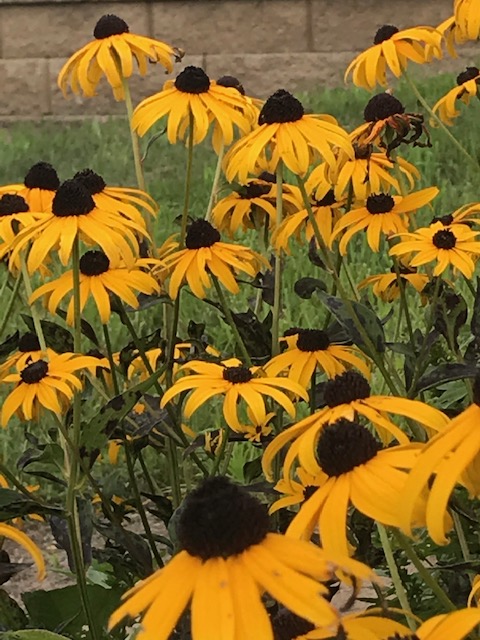
Tomorrow, my husband and I will finally get around to planting part of our yard as native prairie. We have a spot behind our barn that we formally used as a vegetable patch growing corn, peas, bean, peppers, tomatoes, and pumpkins over the years. The patch is not huge, but it is not tiny either. We could do more, as we have a large lawn, but we’ll start with this.
The vegetable garden was never a huge success. We are good at planting the seeds or seedlings, but not good at weeding. So, by August, the garden is usually a mess. The pumpkin patch was fun to have when the kids were young. We grew some Jack O’ Lanterns, some Baby Boos, and some giants that had to be picked up with our tractor to be moved! Those were fun years! Pumpkins provide some ground cover so weeds have a harder time getting the sunlight they need to germinate and grow. They also keep the deer out of the patch with their prickly vines. But, those vines run – and by fall they usually stretched far out into the yard.


More and more I read about prairies and how important they are to our environment. Did you know that we have less than 1% of the North American Prairie left? It’s true. The prairie has almost disappeared! Over the twenty years, I have lived in the mid-west I can attest to the disappearance of the prairie for I’ve seen it with my own eyes! It is imperative we preserve the prairie that is left and even restore some of the prairies if we are able. So, that is what my husband and I decided to do.
The plan actually started two years ago, when a housing development began adjacent to our property. We used to abut to a cornfield. Now, it is a sea of houses built very close together so as to give the developer the biggest bang for his buck. When houses started to be built, several popped up on the lots directly behind the side of our barn. This was my impetus, along with my love for flowers, pollinators, and the prairie, to put a permanent garden in the spot behind the barn. But, it would not be just any garden, it would be a patch of restored prairie.


I did my research on prairie plants native to our area and really focused on “how” to plant a prairie. Killing the weed seeds is essential. So, after we removed the plants two autumns ago, we spread a tarp over the area and stapled it down. The tarp sat over the patch for a year and a half – six months longer than we needed it to stay in place for it to do the job of killing weed seeds. Last fall, with the intention of planting seeds I had obtained specifically for prairie plantings, we removed the tarp.
Well, you can probably guess the rest. Life got busy and we did not get the prairie planted! The area has sat without a tarp all winter! But, tomorrow is the day to get the seeds in the ground! We are going to take advantage of 60-degree weather in March, and get the seeds in the ground. Hopefully, this will prevent the re-induction of weed seeds and not have too much impact on soil structure since we just spread the seeds on the compacted ground. Since the seeds could have been planted in the fall, overwintered in the ground, and germinated this spring, we are going to take the chance with this early March planting. This a last-ditch effort at getting the seeds on the soil for a frost planting. It is preferable to when the temperatures are warmer.
Wish us luck. Tomorrow, I’ll let you know what we planted and how it went!


 The Apples in My Orchard
Leave a reply to Lisa-Beth Lovero Cancel reply