What Are Your Plans For National Poetry Month?
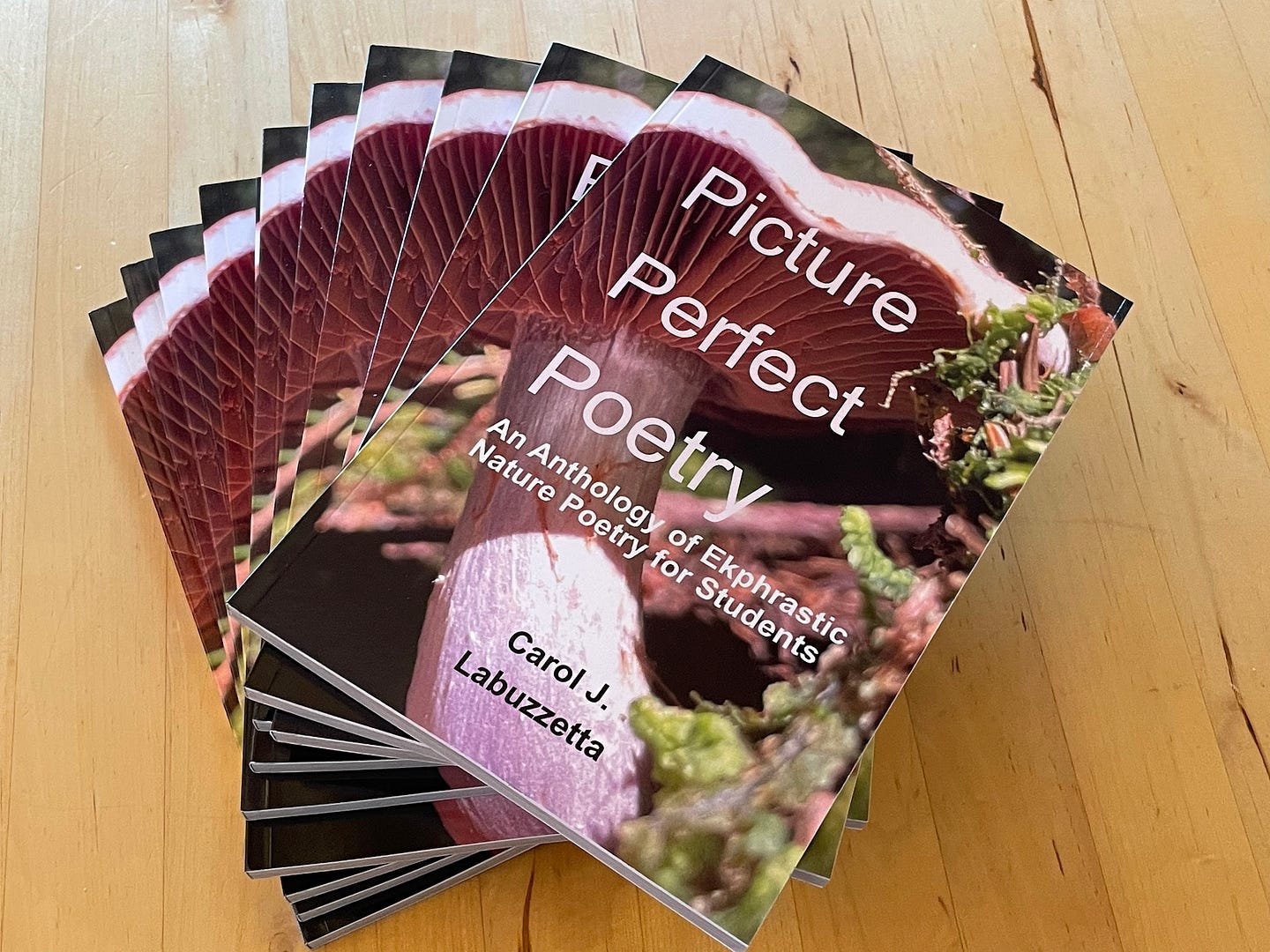
It will be difficult to exceed the release of an indie-published book I had last year.
Last week, I read a post from Mary Lee Hahn about her plans for National Poetry Month. She was considering different forms of poetry to focus on during April. Over the years, I’ve realized it is a special month that needs some special words to rise to the surface and be culled. We certainly have plenty of fodder this year. However, I think most of us want to keep it joyful.
April 2024 was a memorable National Poetry Month for me as I released an anthology of ekphrastic poetry including twenty-five different authors, several from our Poetry Friday group. It’ll be hard to outdo the thrill of that experience. I learned so much while compiling the book and am eternally grateful for the poets who trusted me with their work.
But other than last year, I never focused too much on Poetry Month. When I led a writer’s circle for third-grade students we did our poetry unit in March. I don’t know why — it’s just when it fell.
I think it was because I had them submit to a national compilation of student poetry each year which had a deadline in mid-March. Thirty-three of my thirty-six students over the six years I led the group were published in that compilation. I’m proud of that.

Working with student writers remains one of my favorite enrichment endeavors. It was by working with them on simple poetic forms such as cinquain, diamante, haiku, color poems, and others that I developed a love for poetry.

Last year, when I worked with a refugee student who lived overseas, she had to write an “I Am From” poem. I was to help her with it but our session was canceled that week. When she showed me the final piece, I was both pleased and proud of her. She didn’t need my help at all! The words came from her heart. You could tell. Anything I could have offered would have been interference.
Unlike the younger students with whom I always wrote alongside, I failed to do this with her. Our online sessions were just not long enough. It was critical to address homework issues, and then squeeze in some helpful content, which was hard to do in sixty minutes, let alone write together.
Last week, another participant from our Poetry Friday group, Margaret Simon, offered her I Am From poem. She works with TAG students, something I did as well – although informally – and thus, we share a great fondness for that population. She did as I used to do with my younger students; she wrote with them. In reading her blog post, it reminded me that I wanted to try this form.
It’s taken me a year to get around to writing an I Am From poem. It’s a particularly appropriate time for me to do so after spending so much time with my Dad at his home, near where I grew up, this fall and winter.
I Am From…
I am from fields of apple orchards
And farmlands, near a canal.
Where winters filled with snow
rose to our porch roof.
I am from a place with wide open fields
And vast a freshwater lake
Which looks like an ocean but is not.
I am from a small family without
Aunts and uncles,
But still nourished by others.
Music filled my house, my ears, my soul
It was part of my childhood
And still part of me now.
I am from a place where love lets you go
To allow the freedom to discover
Who is true and what is important.
I am from homemade clothes worn
Proudly to school and church
Made small to fit my frame.
I am from homemade meals,
dinner at the table, and
band practice at night.
I am from a place that resides
Only inside me now,
Called Western New York.
It is a place I'll probably rarely go
Now but carry with me always,
As it is where I am from.

© Draft, Carol Labuzzetta, 2025
Have you written an I Am From poem? I’m not completely sure I like how mine turned out but it’s a start.
I reconnected with my former refugee student this week and asked if I could share her I Am From poem. We’ll see. She might not want me to put it out for all to see – there are safety concerns in working with a refugee population, although she is in the United States now. If I get permission from her and we are both comfortable with her sharing her undying love for her homeland, I will include it in a subsequent post.

Today is Poetry Friday. Our host is Rose Cappelli at Imagine the Possibilities. Rose offers us some of her favorite spring poems today – ones that she shared yearly with students. Thanks for hosting, Rose!


 The Apples in My Orchard
Leave a comment