Two years ago, when I worked for a local land trust, I had to organize education and outreach events. One such event, was Spring Foraging. Okay, it sounded fun but I had never foraged! Luckily, our local university had a mycology club and the student president was more than agreeable to lead the foraging hike with some of the other mycology club members on the first weekend in May.
The hike filled fast. We were to meet at a piece of conserved land in the Southwest part of Wisconsin. Our group was large enough that we had to split into two. But, we had eight university students to help us out! Their enthusiasm as volunteers was contagious! It was a gorgeous spring day on the first Saturday in May.
Foraging takes some skills of observation. One needs to know where to look for mushrooms – the desired find of our hike. One also needs to know which mushrooms are edible and which are not – enter the university students and their knowledge!


Arguably, the most coveted find was a morel mushroom. And, find some, we did!


We also found turkey tail, oyster mushrooms, puffballs, bracket mushrooms, artist’s conk, and more. One of the students was adept at finding the mushrooms and came off the hike with his sweatshirt turned into a bucket to hold them all!
The students were knowledgable about which mushrooms were edible and which were not. However, one of the students told our group that he “tested” them by eating them and popped one in his mouth right in front of us! Let me just say, this was NOT okay. There were a few children on our hike, and no one should be told they can eat a mushroom to see if it is poisonous or not! He did admit to getting sick on several occasions after using this testing method. As the educator on the hike, I had to jump in and tell the group that unless you knew for sure the mushroom you found is edible, you should never eat it! Some ‘shrooms are very poisonous and can cause death! If you don’t know; don’t eat it!
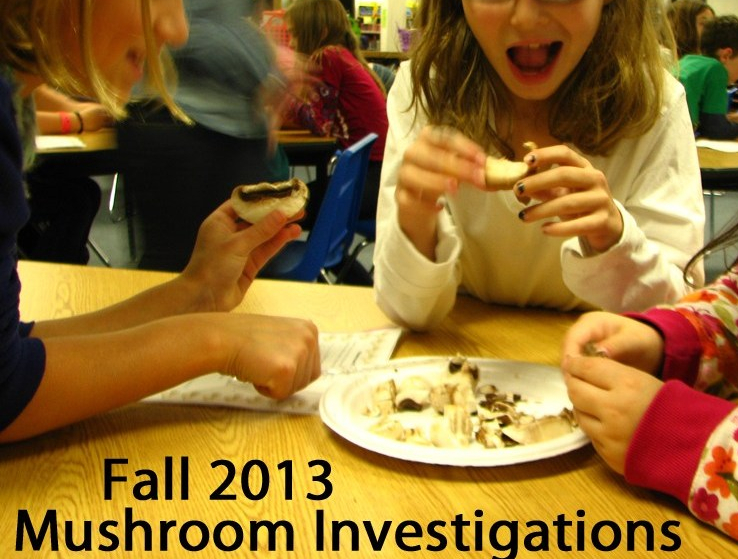
Years prior to this hike, I explored fungi with my garden club students. We did not forage but we did explore these delightful decomposers by dissecting some I bought at the grocery store. (We know the type sold in stores are safe.) We looked at the gills, stems, and caps. We also made spore prints, which turned our very cool! But, we did not eat any!
The hardest part of educating my garden club students (grades 2-5) about mushrooms was explaining that most of the mushroom is under ground, the part we see is only the fruiting body. Most of the mushroom is mycelium, the vegetative part of the fungus, consisting fine strands of whitish string like fibers branching out under the surface of the ground. After trying twice, in two different groups, I gave up on explaining the mycelium to these students. The concept was beyond their grasp.
But, foraging? That is something anyone can do. It helps to have some experts along like we did on our foraging hike – I could have never done this event without the university’s mycology club students lending their wealth of knowledge. I know I learned a lot that day, and I’m sure our participants did too!
Have you ever been on a foraging hike? Is it something you’d like to do? Let me know in the comments!

Today is day 19/31 of the Slice of Life Story Challenge. This annual challenge in March is brought to us by TwoWritingTeachers.org. Thank you to them for creating such a supportive writing community!


 The Apples in My Orchard
Leave a reply to Terje Cancel reply